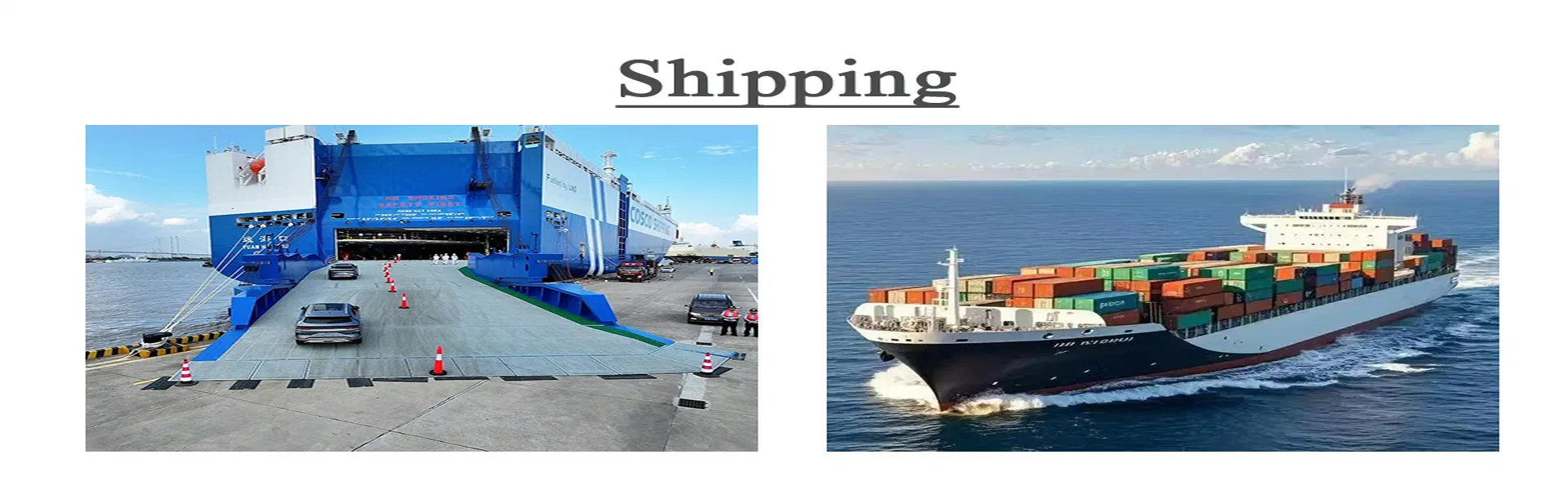
Two ways to move a car from a Chinese port to a West African one, and the choice is not a matter of preference. It is arithmetic that flips at a specific volume.
The pricing models differ, which is the whole point
Container is priced per box. A 40-foot high-cube takes three passenger cars, so the cost divides by however many you actually put in it. Current bands from Nansha: $5,000–5,500 to Tema, $6,000–6,500 to Apapa (Lagos) for the full container.
RoRo is priced per unit. The vessel is a floating car park; your car is driven on and driven off. One car costs roughly what one car costs, regardless of how many others are aboard.
The consequence: RoRo wins for single units, containers win once you have three. Nothing about the ships makes one universally better.
Why containers win beyond price
Security. A sealed container is a sealed container. Nothing is removed in transit, and the seal number is documentary evidence of that.
Protection. No exposure to weather, and no handling by anyone between loading and unloading.
Duty efficiency. Duty is assessed on CIF, which includes freight — so the lower per-car freight of a shared container also lowers the amount taxed. The saving lands twice.
Consolidation of paperwork. One bill of lading covering three vehicles, with a packing list tying them together.
Why RoRo wins where it wins
Single units. No penalty for having one car rather than three.
Vehicles that do not fit a container. Larger commercial vehicles, machinery.
Simplicity. Drive on, drive off. No loading plan, no securing arrangements.
Sailing options. The dedicated vehicle carriers — Höegh Autoliners, Wallenius Wilhelmsen, Grimaldi — run East Asia to Africa trade lanes as their core business rather than as one commodity among many.
What the container network looks like
Container capacity into West Africa has improved substantially, and that shows up as schedule reliability rather than as dramatically lower rates.
CMA CGM’s Asia–West Africa service runs weekly with twelve vessels across eleven ports of call and a full rotation of about 84 days, calling at Qingdao, Shanghai, Ningbo and Nansha on the Chinese side.
On the African side, Lekki Deep Sea Port in Nigeria has changed the regional picture: it has received the 14,812 TEU CMA CGM Scandola, taken delivery of ship-to-shore and RTG cranes, handled its first transshipment vessel, and been added to HMM–ONE Alliance calls. Deeper water and modern cranes mean larger vessels and fewer transshipments.
Practically: more direct calls, more predictable schedules, and less of the multi-leg routing that used to make transit times a guess.
Transit time, honestly
Ask your forwarder for the current figure on the specific rotation you are booking. A published 84-day full rotation is not your transit time — it is the time for a vessel to complete the circuit and return. Your leg is a fraction of it, and it depends on which port you load at and which you discharge at.
Anyone quoting you a confident door-to-door figure without asking which sailing is guessing.
The surcharge nobody budgets for
Rates are not the only variable. Peak season surcharges apply on the China–West Africa trade, and CMA CGM has published PSS notices covering China to West Africa Central and South ranges.
A PSS lands as a separate line item on top of the base rate, and it can arrive after you have quoted your buyer. Ask your forwarder whether a PSS is currently in force or announced for your sailing window before you price a deal, not after.
Insurance
Marine insurance is cheap relative to what it covers and is calculated on the insured value, which flows into CIF and therefore into your duty base. Insure honestly — an under-declared insured value produces an argument at exactly the moment you need the policy to work.
Common questions
Q: Is RoRo cheaper than container shipping? A: For a single car, usually yes. For three cars, a 40HQ container is normally cheaper per unit and more secure.
Q: What does shipping cost from China to Tema or Lagos? A: Currently $5,000–5,500 per 40HQ to Tema and $6,000–6,500 to Lagos, divided across up to three cars, plus any peak season surcharge.
Q: How long does the voyage take? A: Ask for the figure on your specific sailing. Published rotation lengths describe the vessel’s full circuit, not your leg.
Q: Does freight affect my import duty? A: Yes. Duty is assessed on CIF, which includes freight, so freight is part of the taxed amount.